Loot file / 4 nouns
Merchant, loot, loadout
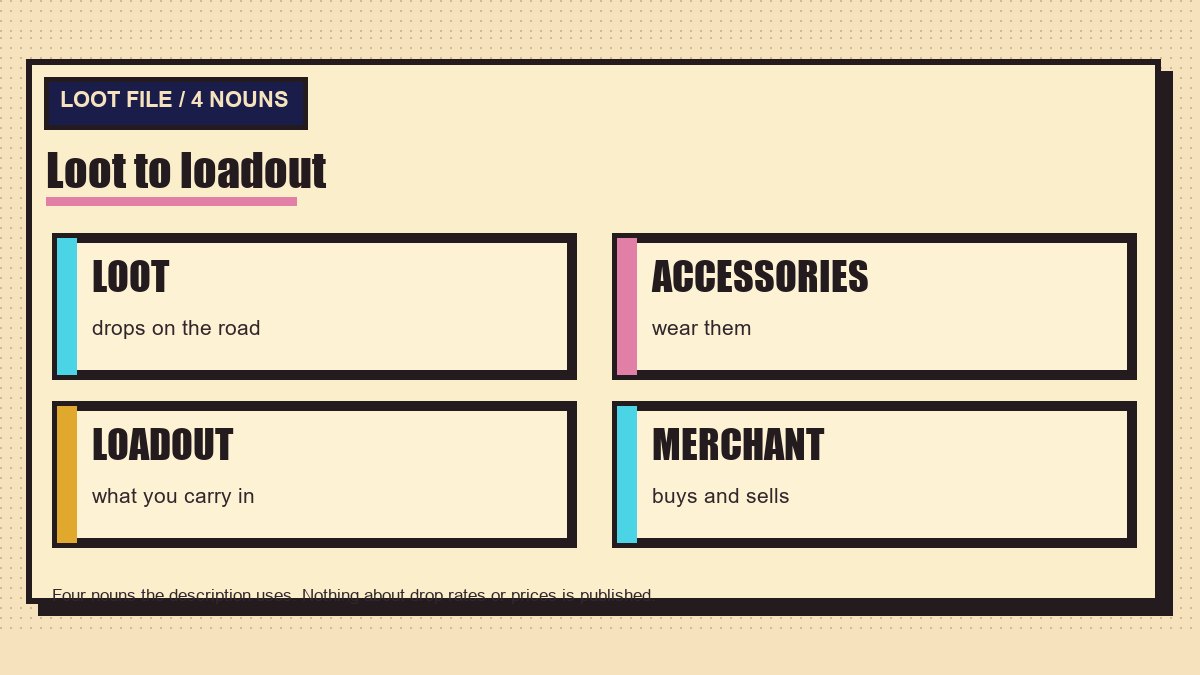
You collect loot and accessories to build a loadout, and you visit the Merchant to prepare for the next encounter. No item prices, drop rates or shop rotation are published.
Four words carry the whole economy of The Bizarre Journey: loot, accessories, loadout and Merchant. All four appear in the game's own description, in two consecutive lines, and between them they describe a complete loop.
The loop in the description's own words
The description says you collect "loot and accessories to build your loadout", and separately that you "visit the Merchant and prepare for your next encounter". Put those together and the cycle is: find things, decide what to carry, spend or trade at the Merchant, go fight.
Read it as a survival economy, not a shop. The Merchant is positioned as a preparation step before an encounter, which means it is a place you visit between fights rather than browse during them.
Four pieces, one cycle
Loot is what the road gives you. The description pairs it with accessories, so expect wearable or equippable items rather than only currency.
Accessories are the wearable half. In a game where every avatar is forced into R6, accessories are one of the few ways a character looks different, which makes them both functional and cosmetic.
Loadout is the decision layer. A loadout implies a limit: you choose what to bring, which means leaving things behind. Hence the Merchant being useful rather than redundant.
The Merchant is the conversion point. Visit, prepare, leave.
| Element | Role | Published numbers |
|---|---|---|
| Loot | drops and pickups | none |
| Accessories | wearable items | none |
| Loadout | what you carry into a fight | no slot count |
| Merchant | preparation between encounters | no prices, no stock list |
Missing numbers, which matter less than they sound
No item prices, no drop rates, no stock rotation and no loadout slot count are published. That sounds like a page with nothing in it, but the structure is still usable: you know there is a decision to make at the Merchant, and you know the decision is about what to carry rather than what to buy for its own sake.
The practical consequence is that you should treat your first Merchant visit as reconnaissance. Look at what is on offer, note the prices in game, and compare them against what you are carrying. That is more reliable than any table, including one written here.
Why accessories are worth more here than usual
Most Roblox games let you keep your avatar's look. This one sets universeAvatarType to MorphToR6, which overrides your avatar with a fixed six-part rig. When everyone's body is identical, accessories and Stand appearance do the differentiating.
That makes accessory loot double-duty: it is gear and it is identity. It also means an accessory you would skip in another game might be worth carrying here purely because it is one of the few things that shows.
Fitting it into the road
The Merchant sits fourth in the description's order, after loot and loadout, before bosses. So the intended rhythm is: gather, decide, prepare, fight. Repeat.
| Step | What you do | Where the Merchant fits |
|---|---|---|
| 1 | summon a Stand | before, since abilities shape what loot is useful |
| 2 | search for loot | the input |
| 3 | build a loadout | the decision |
| 4 | visit the Merchant | the conversion |
| 5 | fight a boss | the test |
| 6 | reach DIO | the end |
The route page runs that sequence in more detail, and the worlds page covers where the loot comes from.